


How Far Should Your Security Cameras "See"? Understanding Detection Range vs. Recognition Range
There's a distinction in security camera performance that most product listings never explain, but that makes a significant difference in how useful your cameras actually are: the difference between detection range and recognition range. Understanding this distinction will help you set realistic expectations and make better decisions about camera placement and system configuration.
Detection Range: The Widest Claim
Detection range is the maximum distance at which a camera can determine that something is in the frame — a person, a vehicle, a moving object. This is the number most commonly cited in marketing materials because it's the largest number available. A camera with a "100-foot detection range" can identify that something is present at 100 feet.
But "detecting that something is there" is very different from "capturing footage useful for identifying what or who it is." At 100 feet, a person might appear as a moving blob of pixels — enough for motion detection software to trigger an alert, not enough to identify gender, clothing, or facial features.
Recognition Range: What Actually Matters
Recognition range — sometimes called identification range — is the distance at which a camera captures enough detail to meaningfully identify the subject. For a person, that typically means recognizable facial features and clothing details. For a vehicle, it means make, model color, and license plate.
Recognition range is dramatically shorter than detection range for any given camera. As a rough rule of thumb, a quality 1080p outdoor security camera can reliably support facial recognition at roughly 15 to 25 feet from the lens. At 40 feet, the same camera will detect a person clearly, but facial identification becomes difficult. At 80 to 100 feet, you'll know someone walked past — and not much more.
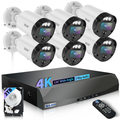
WEILAILIFE publishes both ranges for their cameras, which is more honest than manufacturers who list only detection range and let buyers fill in the gaps optimistically. When you're planning your camera placement, use recognition range — not detection range — as your working distance.
Resolution Changes the Calculation
Higher resolution extends effective recognition range because there are more pixels per frame to work with. A 4K camera has roughly four times the pixel count of a 1080p camera — meaning you can digitally zoom into a section of the 4K image and still have meaningful detail that would be unrecognizable in the same crop from a 1080p image.
For WEILAILIFE's 4K cameras positioned at entry points with wider fields of view, recognition range extends meaningfully beyond what 1080p offers. This is the real-world case for 4K in security applications — not that the full 4K frame looks sharper, but that it preserves usable detail when you need to crop into a specific area of a wide shot.
Focal Length and Its Effect on Range
A camera with a longer focal length (narrower field of view) will capture more detail at greater distances than a wide-angle camera. A varifocal camera — one where the focal length can be adjusted — lets you tune this balance based on your specific placement situation.
For a camera covering a long driveway where the primary concern is identifying vehicles and people approaching from a distance, a narrower focal length that extends recognition range may be preferable to the widest possible field of view. For a front-door camera where the subject will always be close, a wide-angle lens that captures more of the surrounding approach area typically makes more sense.
WEILAILIFE offers both fixed-lens and varifocal options, and their product descriptions include guidance on which use cases each is designed for — which is genuinely useful when you're trying to match camera specs to a specific placement scenario rather than just picking the camera with the most impressive headline numbers.
Practical Placement Takeaway
When planning your outdoor security camera coverage, stand at each planned camera mounting location and estimate the distances to the key zones you're trying to cover. Front door: probably 10 to 20 feet. Driveway midpoint: maybe 30 to 50 feet. Property perimeter from a roofline mount: possibly 60 to 80 feet. Match your camera choice to the recognition range needed at each location, not to the maximum detection range headline.